CUSTOMER STORIES
One Source Refreshments
How a Smarter Dashboard Changes Everything
If you run a vending business of any size, you've probably dealt with a version of this: a customer has a problem, it goes unresolved, and by the time you hear about it, it's not a customer complaint anymore — it's a client conversation you didn't want to have. Jared Detwiler has spent his entire career thinking about this. As VP of Operations at One Source Refreshments — the largest independent vending services provider in the greater Philadelphia area — he's overseen the company's adoption of practically every meaningful technology in the industry. Vending. Micro markets. Office coffee. Pantry services. 25 routes. More than 3,000 machines. And over the last few years, one tool has become a central part to how One Source runs its operation: the ZippyAssist dashboard.

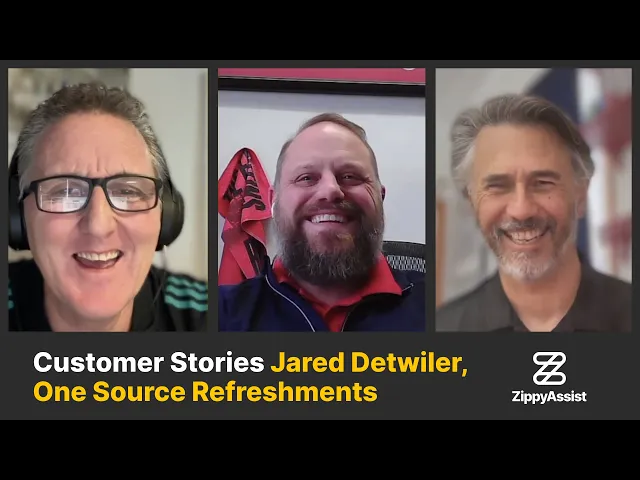
Jared opens up about the ZippyAssist dashboard and how it powers operations at One Source Refreshments.
The Lightbulb Moment: Seeing the Customer on the Other Side of the Glass
One Source had always been a service-focused company. But like most vending and refreshment services operators, their customer service infrastructure was built around their clients — the facilities managers and location contacts who signed the contracts.
What they weren't doing was connecting with the person actually standing at the machine.
"Someone told me: stop and think about how our industry talks to the end customer. We're always so client focused — but you're connecting with the end consumer, which is something we've never done in our industry. And then it's lightbulbs." — Jared Detwiler, VP of Operations, One Source Refreshments
That shift in thinking — from client-focused to consumer-aware — is what led Jared to ZippyAssist. And once he understood what the platform was actually doing, the question stopped being should we use this and became how do we use this better.
The Dashboard: Built Backwards From the Customer
What makes the ZippyAssist dashboard different from a standard help desk or ticketing tool is not just its optimization for unattended retail and self-service refreshments, but how the dashboard was built around the needs of operators.
When ZippyAssist launched, there was no dashboard. Zippy was designed from the consumer experience outward — figuring out the simplest, most friction-free way for a customer to report a problem or ask for help. Once that worked, the data flowing in from consumers could be surfaced to operators in a useful way.
That design philosophy matters for vending and refreshment services operators, because your customers are anonymous. They don't call. They don't email. They just walk away — or walk into the facility manager's office. Building an experience simple enough that people actually use it was the prerequisite for everything else.
The result: a dashboard that didn't get built top-down by engineers, but grew organically from what operators actually needed to see. Voice messages, feedback tracking, service call management, account-level reporting — most of these features came directly from operator requests.
"It's been organic — but organic based on the feedback and input we're getting directly from operators." — Greg Elisara, CEO, ZippyAssist
For One Source, that evolution mirrored their own. Jared describes three distinct phases of how they've grown into the platform — each one unlocking a new layer of what the dashboard can do.
Phase 1 — Refunds: The Visibility You Didn't Know You Were Missing
Ask most vending operators what they spend too much time on, and refunds come up fast. But here's the thing: operators have a hard time nailing down exactly what refunds are costing them.
Before ZippyAssist, One Source had cash refund banks distributed across their larger locations — typically $25 to $37 per site. Drivers were supposed to log every refund. Technicians too. Account managers replenished the banks on visits. In practice, none of it was tracked properly despite best efforts.
"Refunds went out to people that were not charged all the time. And five, ten, fifteen dollars was disappearing nonstop." — Jared Detwiler
The dashboard changed that. Now every refund request flows through ZippyAssist — verified against transaction records, reviewed by a team member, and paid out only when appropriate. One Source pulled their cash refund banks back from almost every location. The exceptions are places where phones aren't allowed or senior centres where digital access is limited.
The numbers tell the story clearly. In January, One Source received 880 help requests across their operation. Of those:
290 were refund requests (~33% of total requests)
Only 140 refunds were actually paid out (~16% of total requests)
More than half of refund requests, on closer inspection, didn't warrant a payout. That's not customers being dishonest — it's operators finally having the information to make the right call.
The insight for other vending businesses: if you're not tracking refunds through a centralized system, you almost certainly don't know what you're paying out, or why. And you’re less likely to know the true cost of the time and resources – above and beyond the refunded money.
Trolley House Refreshments saw a similar pattern when they implemented ZippyAssist — read their experience here.
Phase 2 — Service Calls: From Texts and Phone Tags to One Clean System
Once One Source had refunds flowing through ZippyAssist, the next question was obvious: what else were they managing through fragmented channels?
Service calls, it turned out, were in much need of some TLC. Drivers were texting a service line. Technicians were getting incomplete information. There was no photo record of what was actually happening in the field.
Today, 80–85% of One Source's service calls come through ZippyAssist, including voice messages. Route drivers submit all their service calls through the platform. And because drivers can attach photos, technicians arrive on site with context they never had before.
"Our service calls have gotten much, much better. Drivers always resist change — but once we got them to do it, they're able to give us photos, which give technicians more insight into what's actually occurring." — Jared Detwiler
The dashboard also enabled One Source to build internal triage logic: when a request comes in, the team knows immediately whether it's a driver fix, a technician dispatch, or just a refund. That kind of structured decision-making is only possible when everything is visible in one place.
On voice: about 15–20% of One Source's requests still come in by phone. ZippyAssist captures those too, transcribing voicemails directly into the dashboard. What used to be 25–40 minutes of someone manually writing down overnight messages is now ready to act on the moment the team sits down.
Phase 3 — Account Management: Running Vending Operations From the Dashboard
This is where the dashboard earns its place as a genuine business tool, not just a customer service tool.
One Source runs a bi-weekly service meeting covering open service calls, repeat issues, and equipment flagged for attention. The ZippyAssist dashboard is a core part of that meeting. They also run a Monday morning kickoff call — similar to what businesses like Monumental Refreshments in DC does with their 1,500 micro markets — reviewing what's outstanding and what needs action that week. Prioritization is critical and having data to make resource allocation decisions is “gold”.
The KPIs they track through the dashboard:
Refund requests vs. refunds paid — monitored month over month
Total help requests — trended month over month
Trailing 12-month view — to catch patterns before they become problems
Equipment-level help requests — cross-referenced against their VMS data
That last one matters. Sometimes the issues showing up in ZippyAssist don't show up the same way in the VMS. Having both views catches things that would otherwise slip through.
The account management impact is where operators often see the most unexpected value. Jared shared a recent example: a micro market customer submitted a help request saying the food had been sparse lately. The account manager contacted that person directly, then took it a step further and proactively reached out to the client.
"All we got back was: 'Thank you so much, glad you're on top of it. I don't have to worry about it.' It allows you to be proactive in that respect." — Jared Detwiler
In refreshment services, losing a vending account rarely announces itself. You don't get a warning — you get a call saying they're moving on. Getting ahead of service issues before they reach the client is one of the most direct ways ZippyAssist contributes to account retention.
What You Don't Expect to Learn
One of the most striking things about Jared's experience is how the dashboard surfaced intelligence One Source wasn't looking for — and couldn't have found any other way.
Product decisions driven by data. One Source actually discontinued certain product sizes because they kept appearing on the jams list month after month. They'd tested those products and believed they'd work. The customer data said otherwise.
"We discontinued certain items because they were referenced so often in jams — every month, the same products showing up. We never really expected that." — Jared Detwiler
Google reviews in an unattended world. In an industry where you're rarely present when customers interact with your equipment, getting Google reviews is genuinely hard. ZippyAssist's automated feedback flow — which reaches out to customers after a help request is closed — changes that. Customers who are surprised to get a response, let alone a resolution, are exactly the customers who leave positive reviews.
"Google reviews are super huge in our industry. And it's very hard to get them because we're not present very often. Any ways we can contribute to our web presence is huge." — Jared Detwiler
The Bigger Picture
One Source's experience points to something that applies to vending businesses of any size: the dashboard isn't just a place to handle complaints. It's a window into your operation that you didn't have before.
What changes when you can see everything in one place:
Refunds become measurable and manageable, not a vague drain on the business
Service response gets faster and better-informed
Account managers can get ahead of problems instead of reacting to them
Data you never had before starts shaping product and operational decisions
The client relationship strengthens — because you're solving problems they didn't even know you knew about
"I don't think operators had a good measure of what their refunds were before. This allows us to track, literally month after month, what was requested and what was actually appropriate to pay out." — Jared Detwiler
The ZippyAssist dashboard didn't change One Source's commitment to service. It just made that commitment visible — to their team, their clients, and their customers.
See how Trolley House Refreshments in Virginia uses ZippyAssist to support 700+ clients: read their story here.
Want to see the ZippyAssist dashboard in action? Book a free demo.

11 ZippyAssist Features You Might Have Missed
Next Article

Trolley House Refreshments
Previous Article