CUSTOMER STORIES
When Scale Meets Service
How Pepsi Mid-America Modernized Consumer Support Across 5 States
Pepsi Mid-America knows how to move product. As a major Pepsi Bottler operating across five states, they run one of the more complex distribution and refreshment services operations in the country — thousands of vending machines, nearly 500 micro markets, and 12 regional sales centers humming along at scale.

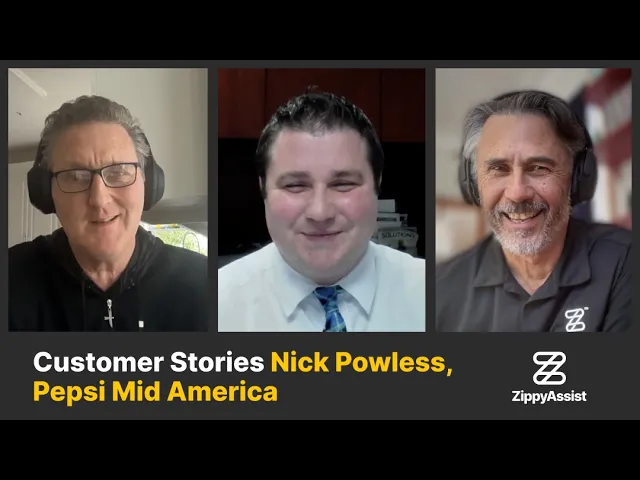
Nick Powless talks about how Pepsi Mid-America built consumer support at scale with ZippyAssist.
But a few years ago, Nick Powless, the company's IT Director, found himself staring at a problem that logistics excellence couldn't solve: the moment a consumer walked up to one of their machines and something went wrong, Pepsi Mid-America had no reliable way to handle it.
That gap — between operational scale and individual consumer moments — is one that every Bottler entering the micro market space eventually runs into. How Pepsi Mid-America closed it is a story worth understanding.
The Challenge Bottlers Didn't See Coming
Nick has been with Pepsi for 14 years. He started stocking shelves while finishing his accounting degree, eventually moving into IT leadership and spending the last eight years driving digital transformation across the organization — migrating legacy systems to cloud-based platforms, building integrations, and modernizing how a very large business runs day-to-day.
Traditional vending, for all its complexity, is built on a transactional relationship with the customer. A machine dispenses a product after the customer pays for it. Traditionally, if something went wrong, the customer was often left stranded.
Micro markets changed that equation completely. Nick knew they needed to provide a better experience when customers faced asking for help.
"The micro markets were the first thing that we implemented, because it is such a challenge to try and manage that customer base. You're transitioning from traditional vending to a consumer-based market." — Nick Powless, IT Director, Pepsi Mid-America
Open-format micro markets mean real consumer interactions — and with that comes a real expectation of support. Someone's card gets held. A product is out of stock. At a vending machine, a customer might walk away. In a micro market, the expectation is different.
Pepsi Mid-America needed a system built for this. And they needed it to work across 12 sales centers, thousands of assets, and a team of route drivers who already had enough on their plates.
Starting with Micro Markets, Then Going Further
ZippyAssist entered Pepsi Mid-America's operation as a pilot — focused initially on micro markets, where the consumer service challenge was most acute. It worked. But what Nick and his team did next is what sets this story apart from a simple software adoption.
They integrated it.
"We didn't just adopt it at this point. We've integrated it with APIs. We've utilized the service that you guys have out of the box, which is integrating it directly with Cantaloupe. So we're syncing our assets. That's just one less thing that you have to worry about as things change every day." — Nick Powless
The Cantaloupe Seed integration means that as assets move — and in an operation this size, they move constantly — ZippyAssist updates automatically. No manual reconciliation. No tickets going to the wrong machine.
But Nick's team took it further still. Early on, they used Microsoft Power Automate to distribute incoming ZippyAssist submissions to relevant team members. Useful — but not precise enough for a 12-hub operation where a submission from one region has nothing to do with the team in another.
So they built a custom API integration. Now, every ZippyAssist submission is batched and routed automatically to the sales center it belongs to — daily, cleanly, without clogging inboxes with irrelevant information.
"We have 12 sales hubs that we distribute to. Giving them the relevant information is important because we don't want to cluster up their inbox any more than it already is with information that's not relevant." — Nick Powless
They also connected ZippyAssist to Zendesk, their broader CRM and ticketing system, via automatic email forwarding — so every consumer submission lands in their customer service team's existing workflow without any manual handoff.
One QR Code, One Asset, No Ambiguity
One detail from Nick's setup is worth highlighting for any large operator thinking about asset management.
From the beginning, Pepsi Mid-America insisted on unique QR codes tied to each individual asset — not just a general location sticker, but a code that identifies the exact machine. Combined with the Cantaloupe sync, this creates a system where a consumer's help request is always traceable to the precise piece of equipment it came from, regardless of where that machine has moved.
"With that being implemented, along with that synchronization with Cantaloupe, I don't have to ever worry about it. Because I know that if that asset moves, I'm still going to know exactly what it is, because it's going to update from either perspective." — Nick Powless
For an operation managing thousands of machines across five states, this isn't a nice-to-have. It's the difference between data you can act on and noise you can't.
ZippyVoice: When Customers Call Instead of Text
Not every consumer reaches for a text message. Some call. Pepsi Mid-America recognized this early and jumped on ZippyVoice — ZippyAssist's automated call-answering feature — as soon as it was available.
They went a step further and recorded a custom greeting, so callers hear something consistent with Pepsi Mid-America's existing phone system. From there, smart routing takes over: calls during business hours connect directly to the customer service team. After hours, the system captures a transcribed voice message and routes it to the inbox.
"It does a great job at interpreting what people are saying and getting that message to us. Most times if they follow the instructions — say the machine number — we immediately know what it is. So it works great." — Nick Powless
The Refund Problem: A Bottler-Specific Challenge
Ask Nick what his favorite ZippyAssist feature is, and his answer isn't what you might expect from an IT Director.
"Peace of mind, maybe. Because I don't have to worry about people not getting their refund. I know that as soon as we click that button to approve the request, they're immediately going to get their refund. I don't have to worry about someone dealing with cash." — Nick Powless
That answer reflects something specific to Bottlers — and to any large operator running a distributed operation without a dedicated consumer support infrastructure.
Before ZippyAssist, refunds at Pepsi Mid-America were handled the way they're handled at many large operations: by drivers. A consumer had a problem, the driver handed over cash from their money bag, or left a float with an HR contact at the account. Multiply that across 12 sales centers, each with their own informal practices, and you get a system that is nearly impossible to audit.
"Having 12 different sales centers where they're all doing different things — they have their own little things — it becomes very challenging to know whether or not the information that we're getting is accurate." — Nick Powless
The accounting challenge for a Bottler is also distinct. Pepsi Mid-America is, at its core, a beverage distribution company. Its financial systems are built around cases and pallets, not $2 consumer refunds. Building a process for issuing individual digital refunds through a large organizational accounting structure required exactly the kind of centralized, auditable system ZippyAssist provides.
"When we say, okay, no more — this is how we're doing it, it's going to be this central method, there is no other way — it allows us to account for that much better." — Nick Powless
ZippyAssist and Zendesk: Different Tools, Different Jobs
Pepsi Mid-America runs both ZippyAssist and Zendesk. That naturally raises the question: why not just use one?
Nick's answer is clear-eyed. Zendesk handles a broad range of submissions across Pepsi Mid-America's distribution business — which is significantly larger than the vending and micro market operation alone. It's the right tool for managing complex, ongoing customer relationships across a diverse business.
ZippyAssist does something different. It's purpose-built for the consumer moment at an unattended retail location — the person standing at a machine who needs help right now, doesn't know who to call, and won't fill out a support form.
"In this context, ZippyAssist is perfect because it handles every aspect of what a vending machine might throw at a consumer. If they're using their debit card, well, there might be a hold. And so you're recognizing that and guiding them through that process — they're getting the information right off the bat." — Nick Powless
He points to a specific scenario where this matters: explaining payment holds to office workers. Pre-authorization holds on debit card transactions are common in unattended retail and almost universally misunderstood by consumers. ZippyAssist surfaces the right explanation at the right moment — something a general-purpose help desk simply isn't designed to do.
"Getting people in an office setting that have no idea what a credit card reader is attached to a vending machine — getting them to understand the complexity of that and explaining it to a customer is practically impossible." — Nick Powless
The two platforms work together, not against each other.
What Other Bottlers Can Take From This
Nick's recommendation to other operators — and particularly other Bottlers considering the micro market space — is unambiguous.
"Absolutely. No question. I don't think that you should handle it any other way." — Nick Powless, on whether other operators should use ZippyAssist
The underlying insight is simple but easy to overlook: micro markets change the nature of the relationship between a Bottler and the people using their equipment. The scale advantages that make Bottlers exceptional at distribution don't automatically translate to the consumer-facing side of the business. That side requires its own infrastructure.
For Pepsi Mid-America, ZippyAssist became that infrastructure — starting as a micro market pilot, growing into a fully integrated platform spanning API connections, asset management, voice routing, and centralized refund processing across five states.
"We're nearing 500 micro markets at this point, and we have thousands of vending machines across our territory as well. So it is a very large and fast-moving operation, and this allows us to effectively manage refunds and customer issues." — Nick Powless
The operation keeps growing. The consumer experience keeps pace.
Want to see how ZippyAssist works for large operators and Bottlers? Book a free demo and talk to our team.
Read how One Source Refreshments — the largest independent vending operator in greater Philadelphia — uses ZippyAssist to manage 3,000+ machines: One Source Refreshments: How a Smarter Dashboard Changes Everything.

Battle-Tested
Next Article

A New Resource for Your Accounts — Ready to Share
Previous Article